
Bajawa Travel Guide: Hot Springs, Villages and Inerie
Bajawa is the cool-climate highland town of the Ngada people in central Flores, and the single best base for hot springs, megalithic villages and the Mount Inerie volcano. Sitting at roughly 1,100 metres on the Trans-Flores highway between Ruteng and Ende, it deserves two full nights on any overland itinerary, not the drive-through most travelers give it. This Bajawa Flores travel guide covers how to get there, the Malanage and Mangeruda hot springs, access to Bena and Luba traditional villages, climbing Inerie, the local coffee culture and honest advice on where to sleep.
Why Is Bajawa Worth Two Nights?
Most overland tours treat Bajawa as a stopover between Wae Rebo and Kelimutu. That is a mistake for three reasons. First, the sights are spread out: the hot springs sit 20 to 40 minutes from town in one direction, the Ngada villages 30 to 45 minutes in another, and combining both into a single rushed afternoon shortchanges each. Second, Bajawa is the cultural heartland of the Ngada, one of the most distinctive highland cultures in eastern Indonesia, with living megalithic traditions you can still see practiced rather than performed. Third, the climate is a genuine relief: after the heat of Labuan Bajo, evenings here drop to 15 to 18 degrees Celsius, and the town has a slow, misty character all its own.
How Do You Get to Bajawa?
As of 2026, nearly every Bajawa Flores travel guide route begins overland on the Trans-Flores highway. The classic route runs Labuan Bajo to Ruteng (4 to 5 hours), Ruteng to Bajawa (another 4 to 5 hours of winding mountain road), then Bajawa to Ende (4 to 5 hours) and onward to Moni for Kelimutu. Bajawa has a small airstrip at Soa, but schedules are limited and frequently change, so it is not something to build a trip around; the reliable airports remain Labuan Bajo (LBJ) in the west and Ende in the east.
The practical implication: Bajawa works best as day three or four of a 4 to 6 day overland crossing, which is exactly how it is sequenced in the Flores overland tour package. Driving yourself is possible but the road demands full attention; a car with a local driver lets you actually watch the volcanoes go by.
Malanage and Mangeruda Hot Springs
Bajawa has two hot spring areas worth knowing, and they are quite different.
Malanage: where a hot river meets a cold one
Malanage, in the Jerebuu valley south of town near Bena, is the more dramatic of the two. A naturally hot river fed by volcanic activity merges with a cold stream, and you can wade along the confluence choosing your own temperature, from scalding near the hot channel to pleasantly warm where the waters mix. It sits in a green valley below Mount Inerie, facilities are basic (simple changing huts, a small parking fee), and it pairs perfectly with a morning at Bena since they are on the same road. Go late afternoon, after the village visits, when the light softens and local families come to bathe.
Mangeruda (Soa): the pool complex
Mangeruda hot springs, often called the Soa hot springs, lie about 40 minutes northeast of Bajawa near the Soa airstrip. Here warm water flows through a landscaped series of pools and a shallow river under shade trees. It is more developed than Malanage, with proper changing rooms and warung food stalls, which makes it the easier choice with children. Entrance fees at both sites are modest; as of 2026 expect roughly IDR 20,000 to 50,000 per person depending on the site, though fees are set locally and do change, so treat that as indicative only.
How Do You Visit Bena and Luba Villages?
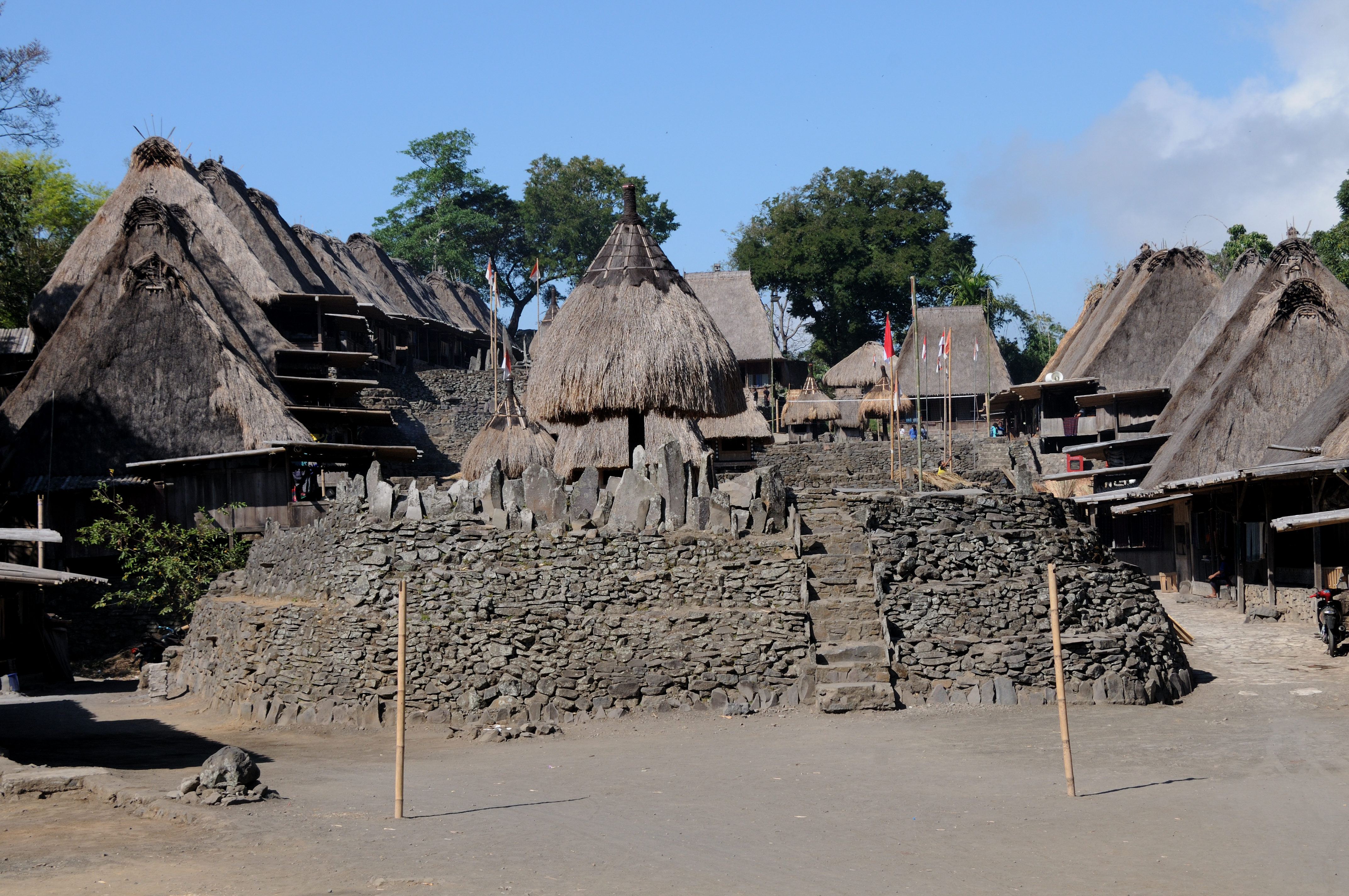
Bena is the flagship Ngada megalithic village: two rows of high-roofed traditional houses facing a central terraced plaza of standing stones, ngadhu (carved ancestor posts) and bhaga (miniature spirit houses), all set on a ridge directly beneath Mount Inerie. It lies about 19 kilometres south of Bajawa, a 40 minute drive on a decent sealed road. Luba, a smaller and quieter village, sits just before Bena on the same road and gets a fraction of the visitors; stopping at both takes little extra time and gives a more balanced picture.
Practical points for a respectful visit:
- Timing: arrive before 9 am or after 3 pm to avoid the midday tour-bus window and the harshest light.
- Donations: each village asks a small entrance donation, typically IDR 25,000 to 50,000 as of 2026 (indicative); you sign a guest book and will usually be offered a woven ikat scarf to wear.
- Etiquette: these are inhabited homes, not a museum. Ask before photographing people, buy ikat weaving directly from the weavers if it interests you, and keep voices low near the ancestral shrines.
- Guides: a local guide transforms the visit, explaining clan structures, the meaning of the megaliths and buffalo-horn displays that otherwise read as decoration.
Note that this guide covers the Bajawa-area villages specifically; Wae Rebo, the UNESCO-recognized cone-house village, belongs to the Ruteng leg of the journey, one or two days earlier on the same overland route.
Can You Climb Mount Inerie?
Yes, and it is one of the finest short volcano climbs in Indonesia. Inerie is a near-perfect 2,245 metre pyramid, and the standard ascent starts around 3 to 4 am from the trailhead near Watumeze so you summit for sunrise. Count on 3 to 4 hours up and 2 to 3 hours down. The trail is straightforward to follow but relentlessly steep, with loose volcanic scree on the upper third; sturdy shoes, gloves for the scramble sections, a headlamp and at least two litres of water are essential. From the crater rim at dawn you see the Savu Sea to the south, the ridgelines of central Flores to the north and Bena directly below.
Climb only in the dry season, roughly April through November; in the rains the scree becomes treacherous and clouds erase the view. A local guide is strongly recommended and inexpensive, arranged through your accommodation or prebooked as part of a private Flores tour so the logistics, permits and an English-speaking guide are handled before you arrive.
Bajawa Coffee Culture
Bajawa arabica is the most respected coffee name on Flores. Grown by Ngada smallholders on volcanic soils between roughly 1,000 and 1,550 metres, it is typically semi-washed in the Indonesian style, producing a heavy body with chocolate and spice notes that specialty roasters abroad pay a premium for. In town you can drink it the local way, strong, sweet and unfiltered, in simple kopi warungs, and several small roasters sell beans direct. If you have a spare half day, ask about visiting a coffee village on the Bajawa plateau during harvest (roughly May to August) to watch picking and processing, and buy beans from the farm gate. It is the best souvenir the region produces.
Where Should You Sleep in Bajawa?
Set expectations correctly: Bajawa has no international chains and no true luxury hotels. What it has, as of 2026, is a spread of family-run guesthouses and small local hotels in and around the town centre, plus a few quieter homestays toward the surrounding villages. Rooms are simple but the good ones are clean, and hot water matters here, so confirm it when booking; at 1,100 metres the nights are genuinely cold. In July and August the better guesthouses fill early, so book ahead rather than arriving on spec. If comfort is a priority, the honest answer is to plan Bajawa as a one or two night cultural immersion between more comfortable bases in Labuan Bajo and Moni or Ende, which is how the private itineraries referenced here are structured.
Bajawa Flores Travel Guide: A Practical Two-Day Plan
| Day | Morning | Afternoon |
|---|---|---|
| Day 1 | Arrive from Ruteng via the Trans-Flores highway; viewpoint stops en route | Luba and Bena villages, then soak at Malanage hot springs; sunset over Inerie |
| Day 2 | Pre-dawn Inerie summit climb (dry season) or coffee village visit | Mangeruda (Soa) hot springs, then continue toward Ende and Moni for Kelimutu |
This two-day block slots naturally into the classic 4 to 6 day Labuan Bajo to Kelimutu crossing. Travel in the April to November dry season for reliable roads, clear volcano views and safe climbing conditions.
Plan Your Bajawa and Flores Journey
A good Bajawa Flores travel guide can tell you what to see; sequencing it smoothly with Wae Rebo, Kelimutu and a Komodo boat trip is where an operator earns its keep. Komodo Luxury runs end-to-end Flores itineraries with private cars, vetted local guides and accommodation booked ahead, from the full overland tour package to fully tailored private tours that finish with Komodo National Park. This site is published by Flores Island Travel, part of Juara Holding Group, which has run travel operations from Bali since 2015 — context worth having when you read the Bajawa hot-spring and village section above.
Use the Bajawa hot-spring and village section above to decide, then use Komodo Luxury’s Labuan Bajo tour packages to confirm.
The Bajawa hot-spring and village section above deliberately avoids quoting you a price, because a real quote has to come from the desk behind Komodo boat charter classes. For the tier above standard, see VIP boat charter. The deluxe class, deluxe boat charter, is the usual compromise between price and comfort.
Combining Hot Springs and Village Experiences Near Bajawa
Many travellers pair the villages with the hot springs that dot the same valleys. This pairing makes sense geographically: several of the most atmospheric hot springs near Bajawa, Malanage and Mengeruda among them, are positioned on the approaches to Bena, Luba, and other Ngada settlements. It’s common to ask a driver to combine stops in a single half-day loop, but don’t underestimate travel times on the winding highland roads.
The hot springs around Bajawa each have their own character. Malanage offers natural riverside soaking with views of the forest, while Mengeruda is a larger, more developed pool complex popular with local families. After walking through the villages, it is worth ending the day at one of the hot springs nearby: a warm soak can ease tired legs and give time to process the cultural encounters.
A few Bajawa guesthouses advertise direct access to a spring. This usually means proximity rather than private baths; most hotels in Bajawa town itself do not have on-site springs, but can arrange transport. For independent travellers, bringing a change of clothes is essential. Flores hot springs soaking tips and etiquette: always rinse off before entering, avoid loud noise, wear modest swimwear (locals often swim in shorts and t-shirts), and be prepared for basic facilities—few sites have true changing rooms.
Many visitors follow a day of villages and hot springs with the Mount Inerie climb the next sunrise. The climb rates as moderate to strenuous, and the steep scree below the summit is the hardest stretch. The sunrise climb up Mount Inerie begins before 3am, with most trekkers reaching the top by first light. Decent fitness, sturdy shoes, and a local guide are all essential for safety.
Frequently Asked Questions
What time of year is best for Bajawa Flores hot springs and traditional villages?
The dry season from April to November is best for the hot springs and traditional villages around Bajawa. Roads are passable, village ceremonies are frequent, and the springs are less muddy. Wet season visits (December–March) can see closures and slippery access.
What is the best way to organise a Bajawa traditional villages tour?
Hiring a local driver for half a day or a full day is the most practical way to reach the traditional villages around Bajawa. Public transport is limited and irregular. Drivers can combine visits to Bena, Luba, and hot springs in one trip, though each site deserves unhurried time.
How do I choose between Bajawa hot springs Flores options?
Malanage is best for a natural, riverside feel; Mengeruda is suited to those wanting family-friendly pools. Both are around 30–45 minutes from Bajawa town. If you prefer quiet, visit Malanage before 10am or avoid weekends when locals attend in large groups.
What gear do I need for a mount Inerie sunrise hike?
For that climb, bring sturdy shoes with grip, a headlamp, warm layers, and at least 1.5 litres of water. The trail is cold and often misty before dawn, and the final ascent is loose volcanic gravel. Guides are strongly recommended for route-finding and safety.
Tell Komodo Luxury your dates and pace, and they will send a day-by-day Bajawa and Flores itinerary with transparent pricing. Message Komodo Luxury on WhatsApp at +62 811 382 3875 or email sales@komodoluxury.com.
Keep reading
More from the journal
-
Kelimutu & Ende
Moni Village Guide: Your Base for Kelimutu
Homestay prices, food, waterfalls, and Ende–Moni transport costs in Moni village, Flores — plus how many nights to stay for…
11 min Read -
Kelimutu & Ende
Ende Travel Guide: Flores’ Overlooked Coastal Hub
Ende Flores travel guide: airport access, the blue-stone beach, Sukarno's exile house, and Ende–Moni transfer prices for your sunrise Kelimutu…
10 min Read -
Kelimutu & Ende
Kelimutu Sunrise from Moni: Times, Costs and Tips
Exact wake-up times, ojek and car costs from Moni, entrance fees, viewpoint walk, best months and drone rules for the…
11 min Read