
Padar and Rinca: What to Expect on Land
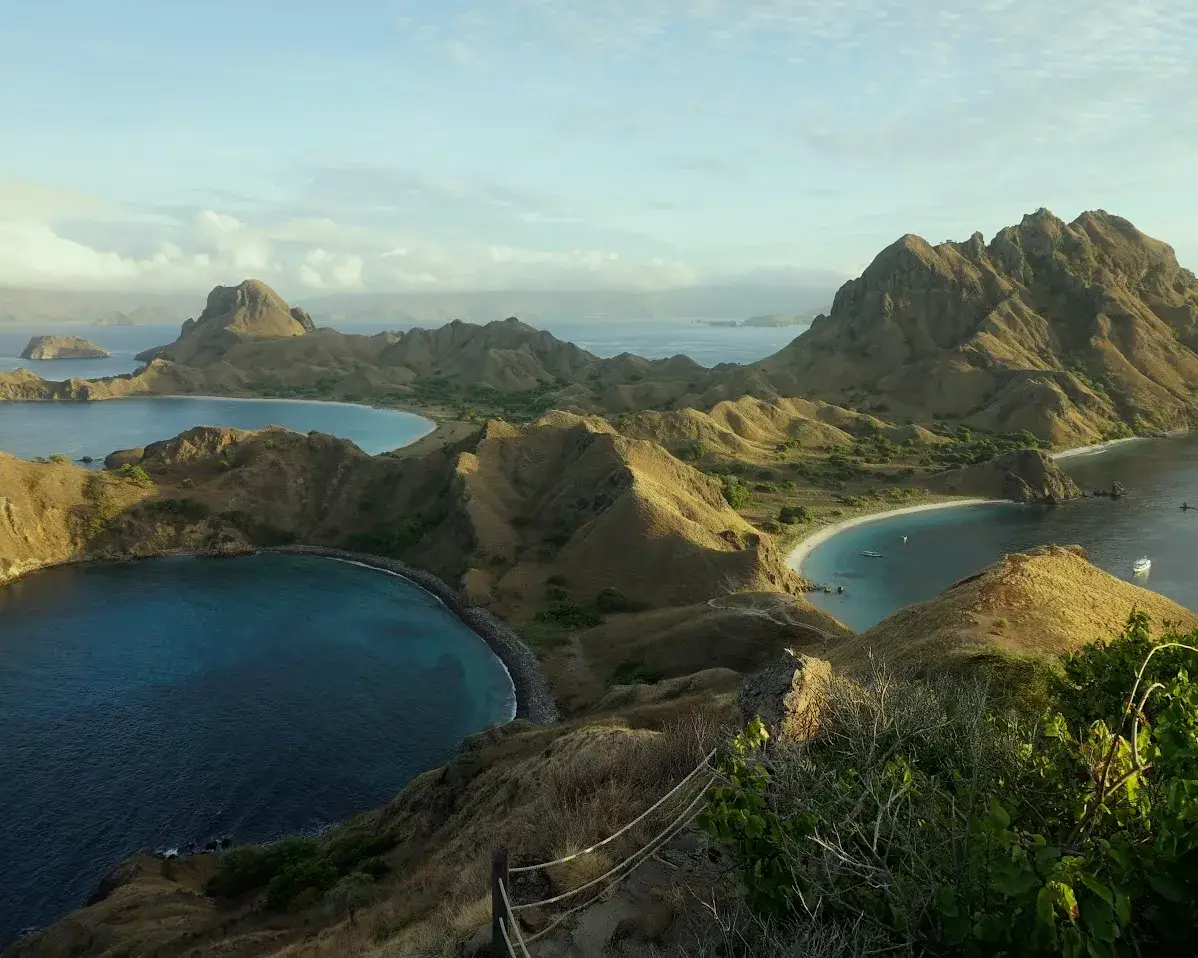
Padar Island is a hiking stop, not a dragon stop — its famous three-bay viewpoint has no dragon population. Rinca Island, with its ranger-run Loh Buaya station, is where most visitors get a reliable, close dragon sighting. Foreign visitor fees follow PP 36/2024: Rp 250,000 PNBP flat, plus a local guide fee (roughly Rp 150,000 per group of 1–5) — budget roughly Rp 400,000–525,000 total per person for the practical day.
Padar and Rinca: What to Expect on Land
Padar and Rinca sit on the same Komodo boat itinerary but deliver two completely different experiences on land — one is a hike for a view, the other is a wildlife encounter with a ranger. Here is what each actually involves, separated out so you know what you’re paying for and what to prepare for.
Padar Island: The Sunrise Hike, Not a Dragon Stop
Padar is famous for one thing: the panoramic viewpoint over its three differently-colored bays, most often photographed at sunrise. It is not a place to see Komodo dragons — the island does not currently support a resident dragon population, unlike Komodo and Rinca. If dragons are your priority, treat Padar purely as the hiking-and-photography stop it is.
The hike to the main viewpoint takes roughly 30 to 45 minutes each way from the boat landing, on a marked but steep and rocky trail with a series of wooden steps and stairs near the top. It is moderately strenuous rather than difficult — manageable for most reasonably fit visitors, including many children, but not ideal for anyone with significant mobility limitations given the uneven, sometimes loose surface underfoot. Sturdy closed shoes matter more here than sandals; the dry-season trail dust and midday heat are the main discomforts rather than technical difficulty.
Sunrise departures typically leave the boat around 5 a.m. to reach the viewpoint as the sun comes up, which is also the coolest and least crowded time of day to climb. An afternoon hike works too if sunrise does not fit your itinerary, though expect stronger sun and, on a busy day, more boats sharing the same viewpoint.
Rinca Island: Where You Actually See Komodo Dragons
Rinca is the more reliable dragon-viewing stop on most Labuan Bajo itineraries, centered on the Loh Buaya ranger station. Rangers lead small groups on a fixed trekking route through the dragons’ natural habitat, and sightings near the station itself — dragons resting in the shade of buildings or along the path — are common enough that most visitors see at least one dragon within the first stretch of the walk. Treks run roughly 1.5 to 2.5 hours depending on the route chosen and how far the group walks into the island’s interior.
Every visitor treks with an armed park ranger, a non-negotiable safety requirement rather than an optional upgrade — you cannot walk the trails independently. Rangers carry a forked stick used to redirect a dragon if one approaches too closely, and they set the pace and distance for the group throughout. For dragon biology, behavior, and detailed safety protocol, we cover that separately in more depth so this page can stay focused on what the land experience itself involves.
Rinca vs Komodo Island: Which One to Choose
Both islands host wild dragon populations and both are reachable from Labuan Bajo, but most itineraries favor Rinca for a simple reason: it typically requires a shorter boat transfer and its Loh Buaya station has a strong track record of near-station sightings, making it the more time-efficient choice on a tight schedule. Komodo Island itself has a larger overall dragon population, and its trails sometimes require walking further to find one, which can matter to travelers with limited mobility or a shorter time window. Neither guarantees a sighting on any given day — these are wild animals, not a zoo exhibit — but Rinca’s shorter, more established routine gives it a practical edge for most standard 2–3 day boat trips.
Entrance Fees: What You Actually Pay
Komodo National Park entrance follows the national PNBP tariff structure under PP No. 36/2024: foreign visitors pay a flat Rp 250,000 per person for park entry — the same on weekdays, weekends, and public holidays, and covering both Padar and Rinca as part of the same park system. This is not the same as the Rp 700,000 figure sometimes seen online, which referred to a 2022 premium-membership proposal that was never implemented as a standard daily tariff.
On top of the PNBP fee, expect a local guide fee (commonly around Rp 150,000 for a group of 1 to 5 people) and small conservation or dermaga (jetty) charges that are typically bundled into your boat operator’s package rather than paid separately at the gate. Adding these together, a realistic total for a foreign visitor’s Padar-and-Rinca day, excluding the boat charter itself, runs roughly Rp 400,000 to 525,000 per person. Always confirm with your operator exactly what is and is not included in your package price before boarding, since bundling practices vary.
Wildlife Beyond the Dragons on Rinca
Rinca’s savanna landscape supports more than just dragons — Timor deer, wild boar, and water buffalo are commonly spotted grazing near the ranger station and along the trekking routes, and they form part of the dragon’s natural prey base, which is part of why the island’s ecosystem holds together the way it does. Orange-footed scrubfowl (a type of megapode bird that builds large mound nests) and various raptors are also frequently seen by attentive visitors. None of this wildlife is dangerous in the way dragons are, but keep a respectful distance from water buffalo in particular, since they can be unpredictable if startled at close range.
What to Bring for a Padar and Rinca Day
Closed-toe shoes with real grip matter on both islands — Padar’s trail has loose gravel sections and stairs, and Rinca’s savanna paths can be dusty and uneven. Bring at least 1 to 2 liters of water per person, a hat and reef-safe sunscreen (there is minimal shade on either island’s main routes), and a light long-sleeve layer if you sunburn easily, since both treks happen in full sun for most of their length. A basic first-aid kit is worth having in your daypack, though rangers on Rinca are trained and equipped for the specific risks of that environment. Camera batteries and phone charge matter more than usual here — you will want both hands free and a charged device for the Padar viewpoint and any wildlife sightings on Rinca.
Planning Padar and Rinca Into a Single Day
Most 2–3 day Komodo boat itineraries cover both islands as part of the same trip rather than as separate excursions — a typical sequence pairs a Padar sunrise hike with a Rinca dragon trek and a Pink Beach snorkel stop on the same or following day. Full-day combination itineraries covering Padar, Rinca, and additional Komodo National Park stops generally run from early morning to mid-afternoon, though exact timing depends heavily on your specific boat’s schedule and route.
A Second Round of Questions
Can you see Komodo dragons on Padar Island?
No — Padar does not currently support a resident dragon population. It is a hiking and viewpoint stop; Rinca and Komodo Island are where dragon sightings actually happen.
How difficult is the Padar Island sunrise hike?
Moderate — roughly 30 to 45 minutes each way on a steep, sometimes loose trail with stairs near the top. Manageable for most reasonably fit visitors including many children, but not ideal for anyone with significant mobility limitations.
Is Rinca or Komodo Island better for seeing dragons?
Rinca is generally the more time-efficient choice, with a shorter typical boat transfer and a strong record of near-station sightings at Loh Buaya. Komodo Island has a larger overall population but sometimes requires walking further to find a dragon.
How much does entrance to Padar and Rinca actually cost?
Foreign visitors pay a flat Rp 250,000 PNBP park entrance fee under PP No. 36/2024, plus a local guide fee (around Rp 150,000 per group of 1–5) and small bundled conservation charges — a realistic total is roughly Rp 400,000 to 525,000 per person, excluding the boat charter.
Do I need a guide to trek on Rinca Island?
Yes, without exception — every visitor treks with an armed park ranger on Rinca. Independent walking on the trails is not permitted, for safety reasons around the wild dragon population.
Continue planning: see the Komodo open trip itinerary for how Padar and Rinca fit into a shared boat schedule, or check the best season for dragon trekking before you book.
Knowing what Padar and Rinca actually ask of you is the useful half of the planning. The other half is a boat, the park permits and a licensed ranger booked for the right morning, which is what Komodo Luxury’s Komodo boat tours organises.
The Padar and Rinca walkthrough above was compiled from public sources, while live availability sits at private trip packages. Every vessel grade is compared at Komodo boat charter classes. For a better cabin and a shorter guest list, VIP boat charter is the upgrade path.
Comparing Padar and Rinca: Logistics, Costs and Dragon Encounters
If you’re choosing between Padar and Rinca from Labuan Bajo, each requires different expectations and planning. The Padar climb is moderate for most people: 30 to 45 minutes up rocky, often dusty steps to the viewpoint. Trainers or hiking shoes, not sandals. While physically manageable, the real challenge is the early morning wake-up for sunrise tours, which are essential for beating both the heat and crowds.
For budgeting, the Padar landing is currently covered by the Komodo National Park ticket, which includes both Padar and Rinca landings under a single daily rate. Rinca charges the same national tariff as the rest of the park. However, Rinca also requires you to pay a local guide fee per group—this is not optional and is collected on arrival at Loh Buaya.
On Rinca, the danger to hikers is real but controlled; all visitors must join a ranger-led group. Komodo dragons are wild apex predators and unpredictable, especially when food is present or during the nesting season. Rangers are equipped and trained to manage encounters, but strict rules—such as no leaving the group and no sudden movements—are enforced for safety.
For actual sightings, the best window is the dry season (April–November), when dragons are more active and visible on open ground. If the question is where to actually see dragons, the answer is Rinca. They do not roam around Labuan Bajo. The real debate is whether Rinca or Komodo Island is better for dragon watching. Rinca generally offers easier access and higher sighting reliability due to the density of dragons near the station, but Komodo Island treks can feel less crowded and more remote, albeit with less guarantee of seeing a dragon up close.
More Questions Answered
Is Rinca Island open for tourists?
Yes, Rinca Island is open for tourists and is a regular stop on Komodo boat tours. The Loh Buaya ranger station is fully operational, with daily guided hikes and group schedules. Visiting hours normally run from 7:00 AM to 4:00 PM, but check for possible closures in the rainy season or during maintenance periods.
When is the best time to see Komodo dragons?
The best time to see Komodo dragons is in the early morning between 7:00 and 10:00 AM, when temperatures are cooler and dragons are most likely to be active. Avoid midday visits if possible, as dragons tend to seek shade and rest during peak heat.
What is the best season for Komodo dragons?
The best season for Komodo dragons is the dry season from April to November, when trails are less muddy and dragon activity is higher on open ground. December to March is wetter, with fewer dragons visible and occasional closures for trail repairs.
Can I see Komodo dragons from Labuan Bajo?
No, you cannot see Komodo dragons in Labuan Bajo. All dragon encounters require a boat trip to either Rinca or Komodo Island, both of which are inside the Komodo National Park and not accessible by road from the mainland.
When are the Komodo dragons most active?
Komodo dragons are most active in the morning between sunrise and late morning, particularly after overnight rain or cooler weather. Outside these hours, they retreat to shade and become lethargic, greatly reducing the chances of an up-close sighting.
Keep reading
More from the journal
-
Komodo & Boats
Combining Flores and Raja Ampat in One Trip
Flores and Raja Ampat can be combined into one trip, but they are not next-door destinations — there is no…
11 min Read -
Komodo & Boats
Is Komodo National Park Open? Status Explained
Komodo National Park is open to visitors. It has never been fully and permanently closed, despite repeated news cycles suggesting…
10 min Read -
Komodo & Boats
Komodo Dragons: Facts and Safety Rules
Komodo dragons are the world's largest lizard, growing up to about 3 meters and 70–90 kilograms on average (the largest…
11 min Read